
How it works
Your website goes in. Revenue-tracked ads come out.
Your marketing department works in six steps, and you only touch two of them: answering six plain questions, and pressing approve. Everything below is the product as it actually runs. These are real screenshots.
Paste your website. That's the onboarding.
StealthAds reads your site the way a new creative hire would on day one, your products, your prices, your claims, your photography, even your exact shade of brand colour and how rounded your buttons are. It becomes brand memory: the thing every ad is written from.
No brand questionnaire. Your site already answers it.

Answer six questions. None of them are ads jargon.
What you sell, what it costs, where clicks go, what you can spend. You never see a campaign objective, a bid strategy or an ad set. The wizard derives all of that, and it does the one piece of maths first-time advertisers never get told about: whether your budget can actually reach the point where the platform stops guessing.
Type $40 a day and it tells you, before a cent moves, why that will swing around for weeks, and exactly what to change.
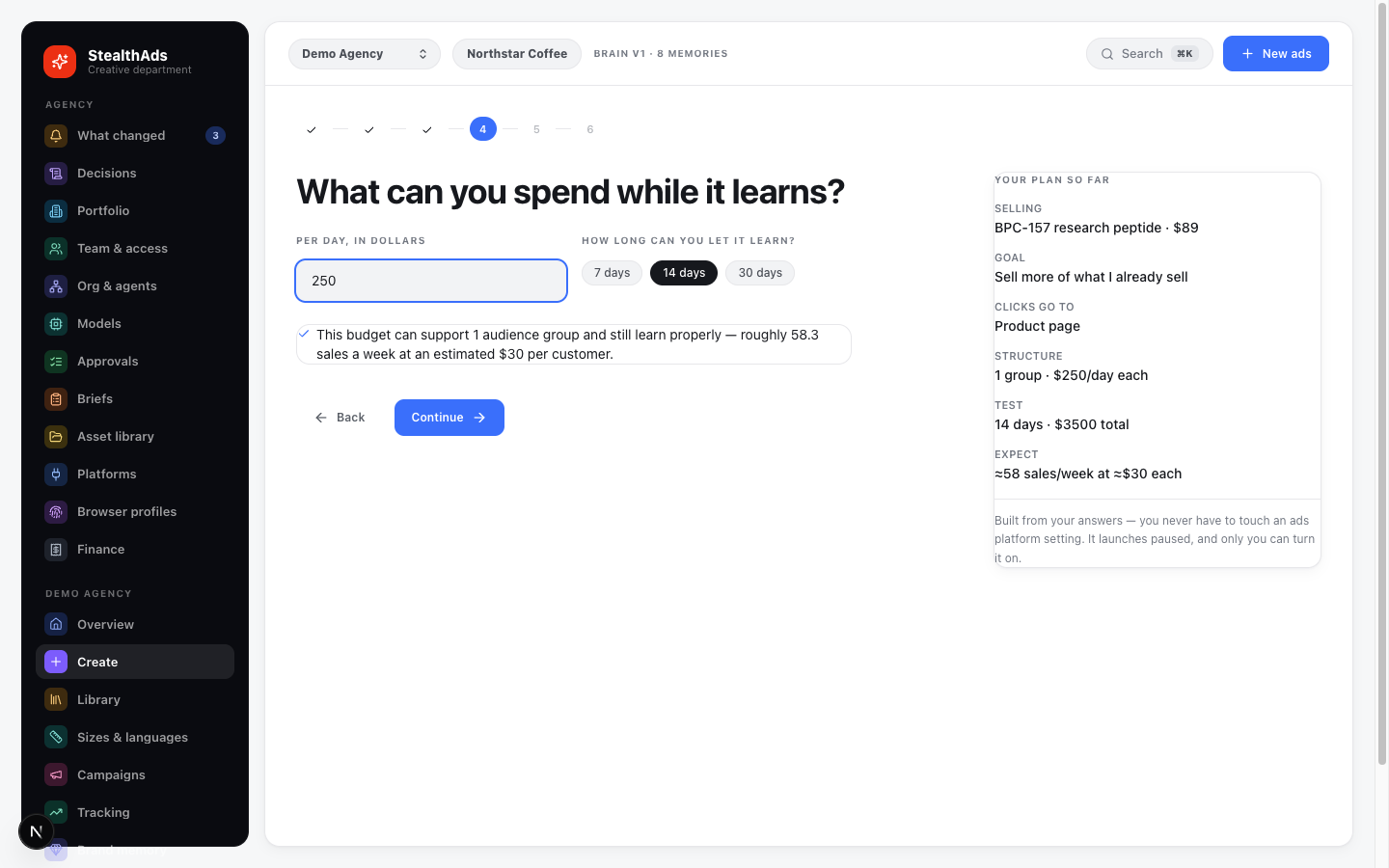
The real screen. The plan on the right assembles itself as you answer.
Every ad clears the gate for your category. Or it doesn't exist.
Your vertical has rules, legal ones, platform ones, yours. Every headline, script, FAQ answer and landing page line goes through the same fail-closed check before you ever see it. An ad that breaches a rule isn't flagged for you to catch. It's refused, with the reason.
The same gate covers your emails and landing pages, because a claim is the same claim wherever it appears.
The compliance gate
Refusal with reasons is the product working. A breach is logged instead of shipped.
You read a plan in plain English. You press approve.
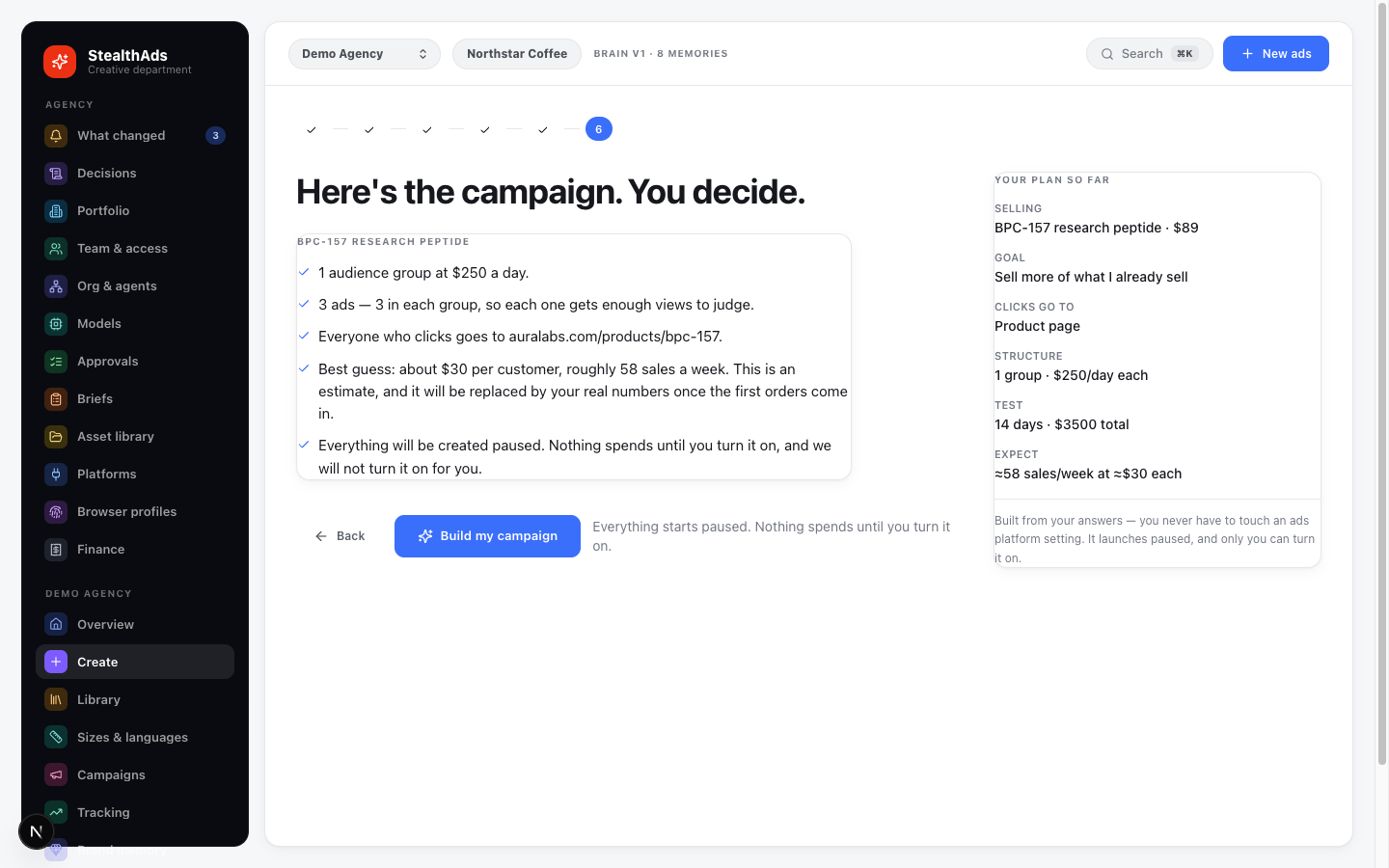
The last screen isn't a form. It's the campaign described the way a colleague would describe it. And the sentence that matters is always there: everything is created paused. Nothing spends a cent until you turn it on, and we will never turn it on for you.
A human on every publish isn't a limitation. In these verticals it's the moat.
The ads get made. Statics, video, landing pages.
Concepts from your brand memory and what's working in your category. Photoreal statics in your palette. Video. Landing pages that match your site's own colours, fonts and corner radius, because a page that doesn't look like your brand reads as a scam page, and your buyers know it.
Every ad below was generated by this product.




Your store reports back. The ads start learning.
A plugin for WooCommerce, Magento, PrestaShop or OpenCart, or a snippet for anything else, matches every order to the exact ad that caused it. Refunds reverse revenue. And the dashboard tells you what it can't see, because a dashboard that hides its blind spots overstates every number on it.
That honesty is the feature. When it says an ad is winning, you can move budget on it.
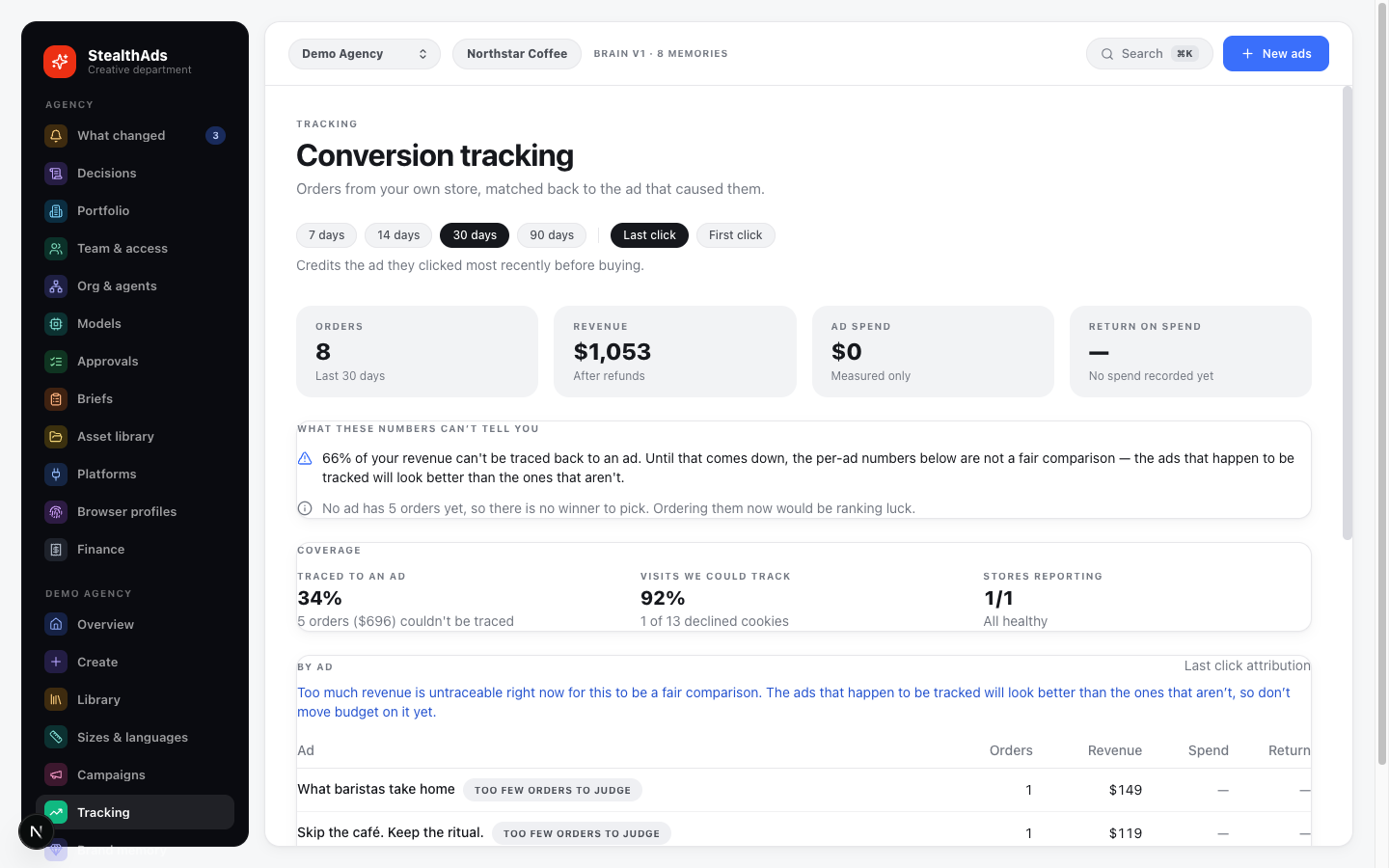
Demo data. Note the panel that says what the numbers can't tell you. That ships to every client.
Then it does it all again, smarter.
Real revenue calibrates the scoring. The next batch of concepts starts from what actually sold, not what got clicks. That loop is the whole product, and it compounds every campaign you ship.
Start with your website →Free to try. Nothing spends without your approval.